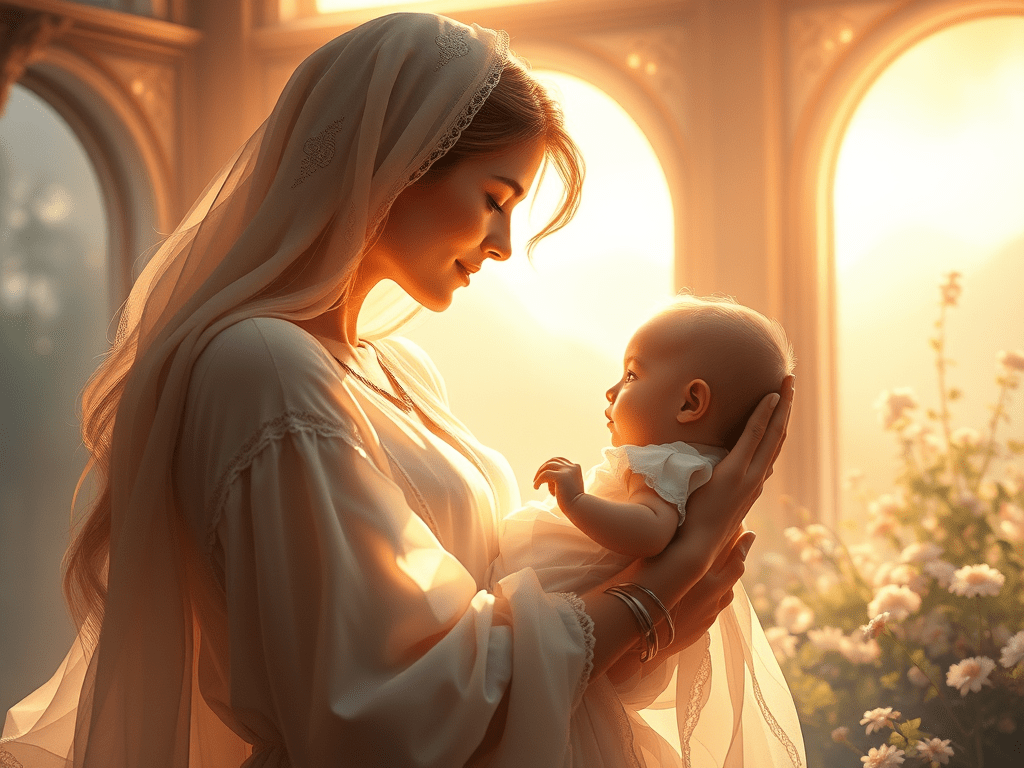
One of the great spiritual mistakes of modern life is the assumption that holiness arrives fully formed—or not at all. But Christianity has always insisted on something far more human, and far more beautiful: we are made to learn our way into love. Motherhood, in a profound and often hidden way, is one of God’s chosen classrooms for this learning.
St. Thomas Aquinas reminds us that angels do not learn as we do. Their knowledge is infused, complete, and instantaneous. Human beings, by contrast, come to knowledge slowly, through experience, struggle, habit, and growth. God, who knows exactly what He is doing, meets us precisely there—on the path, not at the finish line.
Motherhood fits perfectly into this divine pedagogy. It is not a state of instant sanctity, but a process of being shaped. Like the disciplined training of the body—where repeated movements form strength over time—motherhood forms the soul through daily acts of sacrifice, attentiveness, and love. What we repeatedly choose, we become.
This is why Christianity has never been embarrassed by suffering. Not because suffering is good in itself, but because God can use it to deepen love. The saints testify to this again and again. Father Jean C.J. d’Elbée recounts, in his book I Believe in Love, Christ’s words to St. Gertrude: that a trial accepted in trust prepares “a more beautiful Heaven.” We still pray for healing, of course—but always with the humility that God’s plan may be more luminous than our own.
The modern world often proposes the opposite vision. Comfort, wealth, and endless choice are presented as the path to fulfillment. Yet study after study—and Scripture itself—suggest otherwise. Jesus’ warning that we cannot serve both God and money is not moral scolding; it is spiritual realism. Prosperity, untethered from sacrifice, often dulls our desire for God rather than sharpening it.
Motherhood stands as a quiet contradiction to this logic.
From the beginning, Scripture affirms motherhood as something very good. Before sin entered the world, woman was already created with the capacity to bear life. Pain came later; vocation came first. And in the fullness of time, God did not redeem the world through an abstract idea or a disembodied act of power, but through the “yes” of a mother. Mary’s fiat reveals forever that motherhood is not marginal to salvation history—it is woven into its very center.
In a culture that has increasingly portrayed motherhood as a burden, a loss of freedom, or even a form of oppression, the ache beneath the rhetoric is becoming visible. We hear it in art and music, in stories of success shadowed by regret, in women who have achieved everything they were told would satisfy—yet still sense something missing. These are not arguments; they are laments. Consider Kelsea Ballerini’s song, “I Sit in Parks”.
And God listens closely to laments.
Many women deeply desire motherhood, sometimes discovering that desire later than expected, or in ways that look different than imagined. Others are called to a form of spiritual motherhood—religious sisters, mentors, prayer warriors, women who hold countless lives within their hearts. The Church has always understood this: motherhood is not only biological; it is formational.
Even the body itself tells this story. A woman’s cyclical design is not a flaw to be corrected, but a sign of health and openness to life. It reveals a profound truth about human flourishing: we are made not merely to produce, but to receive and give life.
Motherhood, then, is not an obstacle to holiness. It is one of its most ancient and demanding paths.
To the mother in the thick of young children or demanding days: your hidden sacrifices are not invisible to God. Lift them to Him. Practice gratitude, maybe in short prayers throughout the day. This season will not last forever—but its fruits will.
To the woman who believes she has “missed the mark”: God is never finished writing your story. Love can still expand your heart beyond what you imagine.
Wherever you are, your womanhood is not an accident. It is a gift—treasured by God, ordered toward love, and capable of extraordinary holiness.
Ask the Lord today how He is inviting you to live it.





 Veritable with Emma
Leave a comment