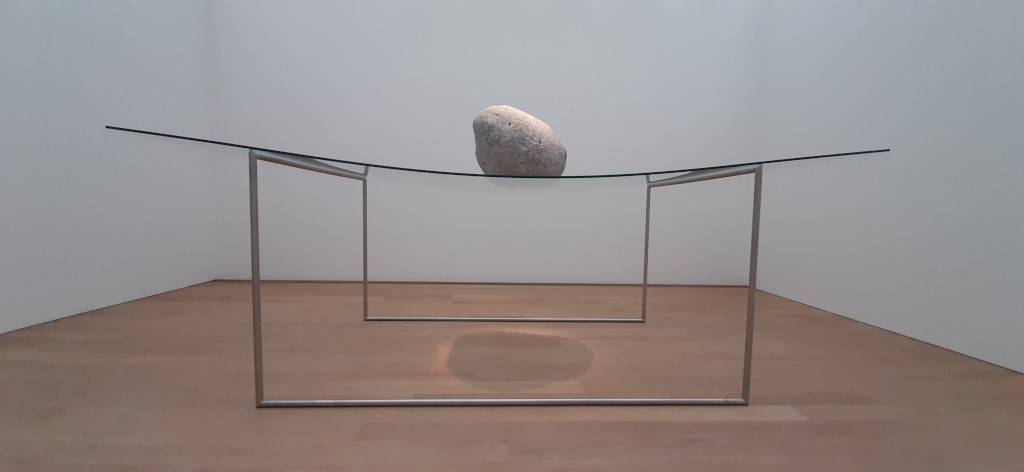
Everyday Life (2025) © Arcangelo Sassolino © foto Wilma Lankhorst.
In one gallery, an 820-kilo rock rests on a single sheet of glass. It has been there for a year, and it looks as if the glass could give way at any moment.
This is Arcangelo Sassolino’s Stillness in the Storm, and the whole room seems to hold its breath around it. The fragile glass and the heavy stone pull against each other, and you can’t help waiting for something to break.
What struck me most was the museum guide. It shows how the glass has changed. It started out perfectly straight, and over the past year it has slowly bent into a deeper and deeper curve under the rock’s weight. The artwork isn’t just the rock and the glass. It’s what happens to them over time.
How art learned to see
Walking through Dutch museums, I’m often reminded that art traces how our thinking has grown.
The earliest works in the Rijksmuseum are flat: flat figures standing in flat landscapes. Then, period by period, art made leaps. Painters discovered perspective and depth. Later came the experiments. Pointillism built pictures out of tiny dots of colour, and abstraction stripped things back to their essential lines and shapes.
Our ideas have moved in similar ways. That stripping back in art mirrors something in philosophy: the urge to break ideas down into their core parts and then try to rebuild them. Many of these movements feel like experiments we run as a society. Each time we shift our frame and adjust our context, we find a new way to understand the world.
A new dimension
Now I see art reaching for something new. It’s asking what happens over time.
Imagine earlier art looked at life on an X and a Y axis. Now it’s as if a new axis has been added. We went from beautiful scenes painted in two dimensions, to sculpture in three, and now to art that moves and changes. This new art unfolds along the axis of time.
So what does that mean for how we think?
Snapshot love
Lately I’ve been thinking about love.
Since the 1960s, we’ve been running experiments on it. Is love affection? Desire? Happiness? What is marriage for? How do parents best love their children? How should we relate to the bigger groups we belong to, like our family, our nation and the world?
Often, though, we’ve settled on a “moment in time” kind of love: the attraction or affection of right now. That’s not surprising in a culture that puts pleasure first and centres on what adults enjoy. But it’s a snapshot version of love, based on feelings and living only in the present. Snapshots don’t hold up well under the weight of time.
Love that lasts
Thomas Aquinas, the great thirteenth-century theologian, defined love as “willing the good of the other.” Take that definition and stretch it across time, and the other versions of love start to look rather two-dimensional. It’s like standing in front of an early painting. It has its charm, but next to a fully three-dimensional work it seems almost childlike. Art has grown up, and I think our understanding of love is growing too, even if we don’t quite have the words for it yet.
Consider a few questions:
- What does it mean to will the good of your husband or wife over an entire lifetime?
- What does it mean to will the good of your children, so that they grow into truly good people?
- How do we love our wider communities over time, from family and city to nation and world, knowing our actions ripple into the second, third and twentieth generations?
What we do affects other people. That’s simply a fact of life. So the real question is how we carry that responsibility well. How do we love in a way that, over the years, actually moves people toward what’s best for them?
That can feel overwhelming. But I remind myself that I’m not the first to walk this road. God has given us wisdom and direction through Scripture and through generations of faithful believers, across many cultures and eras.
Paul hinted at this long ago. Love “bears all things, believes all things, hopes all things, endures all things” (1 Corinthians 13:7). Every one of those words takes time.
A longer love
So let’s move beyond snapshot love, with its short loops of attraction, feelings, breaking up and starting over. Let’s learn instead the crunchy, complicated journey of loving one person over a lifetime of marriage. Let’s love our children over their whole lives, for their good rather than for our own desires or wishes. (Katy Faust’s work explores this well.)
That kind of love is less like a snapshot and more like the glass in Sassolino’s gallery. It carries real weight, is shaped by it over time, and still holds.
Let us love well, for the good of the other, over a long, long time. And perhaps along the way we’ll begin to understand God’s eternal love for us, the steadfast love that “endures forever” (Psalm 136), a love that wills our good always.






Leave a Reply